Restaurants are one of the best first markets for selling websites. There are many of them, the owner is usually on site, and the job of the site is simple: show the menu, hours and location on a phone. They are also busy, wary of sales calls and careful with money. This guide covers how to work with that, from building your list to the words you use at the door.
How many restaurants have no website?
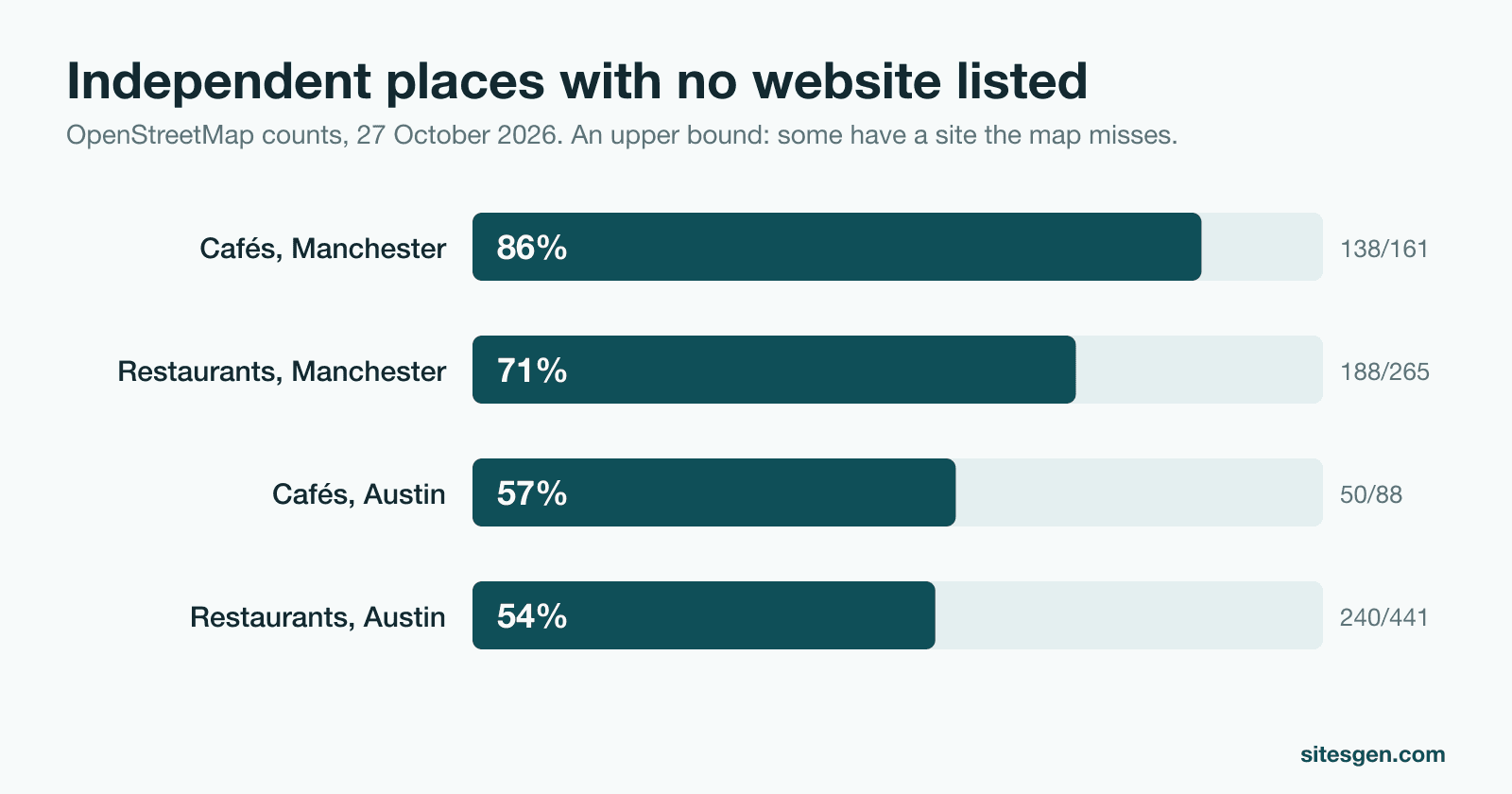
A lot, at least on the map. On 27 October 2026 the niche finder counted independent places in two cities and how many list no website on OpenStreetMap:
| City | Restaurants with no site listed | Cafés with no site listed |
|---|---|---|
| Manchester, UK | 188 of 265 (71%) | 138 of 161 (86%) |
| Austin, TX | 240 of 441 (54%) | 50 of 88 (57%) |
Treat those as upper limits. Map data is added by volunteers, and many businesses have a site that nobody listed, so check each name. Even if only half the Austin figure holds up, that is about 120 restaurants in one city. Pull yours with the businesses without websites finder, or use the lead generator for a CSV.
Which restaurants to contact first
Sort your list before you pitch. The strongest prospects have:
- Plenty of recent reviews. People already look them up, and those reviews make good site content.
- Their menu only on Facebook, in photos, or in a PDF. The problem is easy to show.
- A single owner who works there. One person decides, and you can meet them.
- Heavy use of delivery apps. They may welcome a page they control.
Skip chains, franchises, and anywhere that looks close to shutting. A place in trouble is a risky client: it may not be able to pay you.
What a restaurant website has to do
Owners do not need much, but what they need must work on a phone. Diners usually arrive hungry and in a hurry.
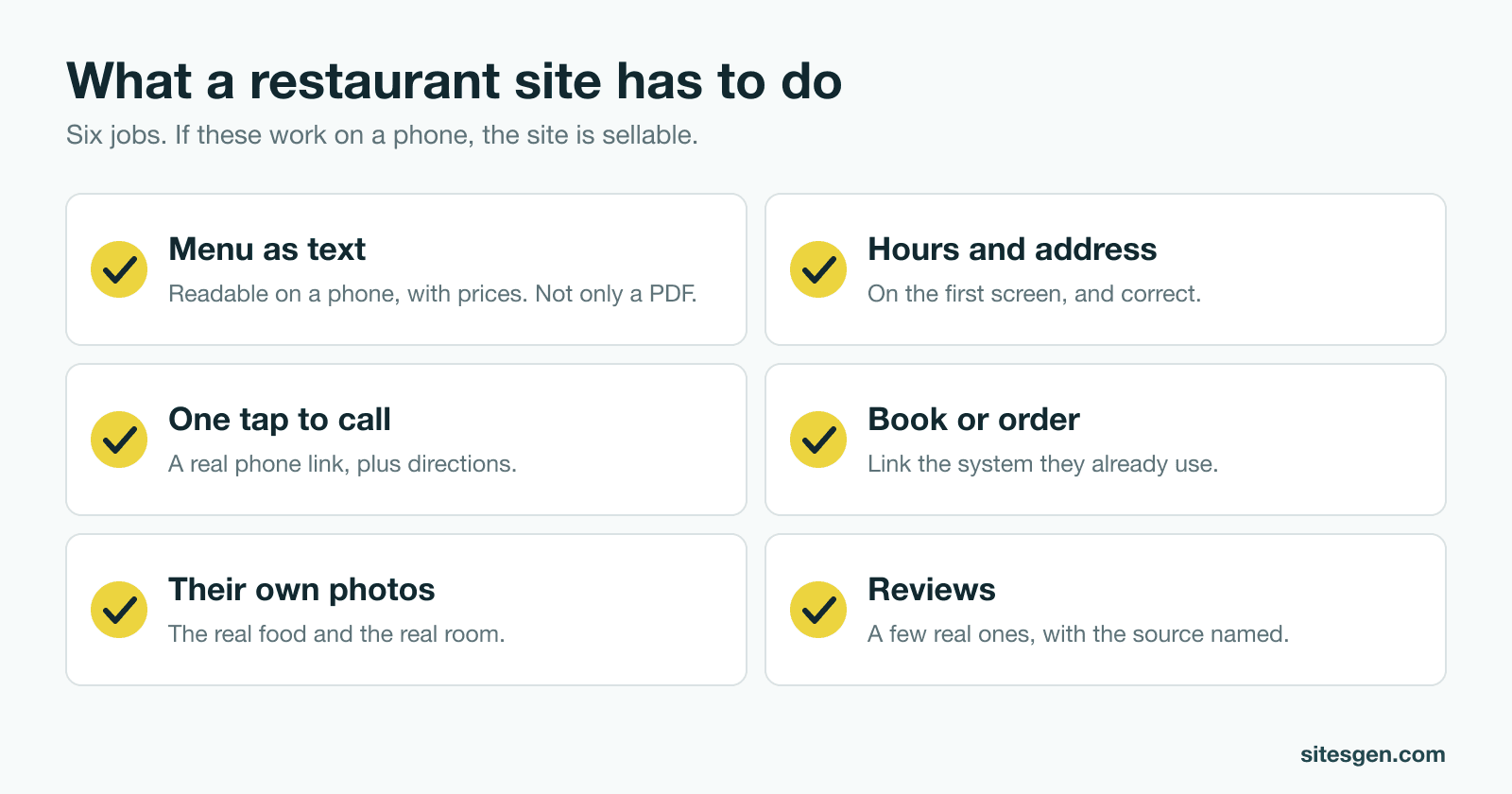
The menu is the page that matters most. A photo of a paper menu cannot be searched or resized, and it goes out of date. That single issue is often your best way into the conversation: open their current menu on your phone and show them what a customer sees.
Also point owners to their Google Business Profile. It should link to the new site and show the same hours. Offering to check it costs you five minutes and shows you care about the outcome, not just the invoice.

When and how to approach the owner
Timing is the part that trips up new sellers. Never turn up during service. Mid-afternoon, between lunch and dinner, is usually the quiet window. Look at the hours first, go early in the week if you can, and start by asking whether it is a good moment.
What you say depends on the channel.
In person
Hi, is the owner around? I’ll be quick. I eat near here and noticed your menu is hard to find on a phone, so I made a draft of a site for you. Can I show you for 30 seconds?
Only say you eat nearby if you do. Better yet, eat there first. You will have something real to say, and owners notice.
By email or message
Hi Rosa, people in your reviews keep mentioning the lamb ragù, but I couldn’t find your menu online without opening Facebook. I drafted a site to show what it could look like, with the menu readable on a phone: [link]. It’s private and there’s no obligation. Is anything wrong or missing?
Why build first? Because “your menu, already working” beats “I build websites” for someone who gets sales calls every week. The demo-first guide covers when that is worth your time, and how to keep drafts private and honest.
Objections you will hear from restaurant owners
- “We’re on Instagram.” Keep it. Instagram shows the food. The website answers the questions Instagram is bad at: the full menu, hours and how to book.
- “We’re on the delivery apps.” Those are good for orders. A site is a page you own, and it can point people to direct ordering or booking. Avoid quoting commission figures unless you know that restaurant’s deal.
- “Our menu changes all the time.” That is the reason for a monthly plan. Send a photo of the changes, and it is updated within a day or two.
For word-for-word replies to the rest, see what to say when a business says it doesn’t need a website.
What to charge a restaurant
A small independent restaurant site commonly sells for $800 to $2,500. See the restaurant website cost guide for what moves that number, or price the exact scope in the pricing calculator.
| Package | Includes | Typical price |
|---|---|---|
| Menu site | One page: menu, hours, map, call button | Lower end of the range |
| Full site | Home, menu, about, contact, photos, booking link | Middle of the range |
| Site plus ordering | Full site, set up with their ordering or booking system | Upper end, or more |
Restaurants watch cash flow closely, so it helps to offer a modest build fee with a monthly plan. Menus and hours change often, which makes restaurants natural care plan clients.
After the sale
- Check that the menu and hours match reality, with the owner, before launch.
- Update the Google Business Profile link, and the Instagram and Facebook bios.
- Put a QR code to the menu on the receipt or the window, if they want it.
- Ask for a short quote and an introduction to one other owner.
Restaurant owners know each other, so the first client in a neighbourhood is the hardest to get. If you want to start with the whole list built for you, SitesGen finds the restaurants in an area, reads their menus and reviews, builds each a site and writes the pitch. Or start free with the finder.