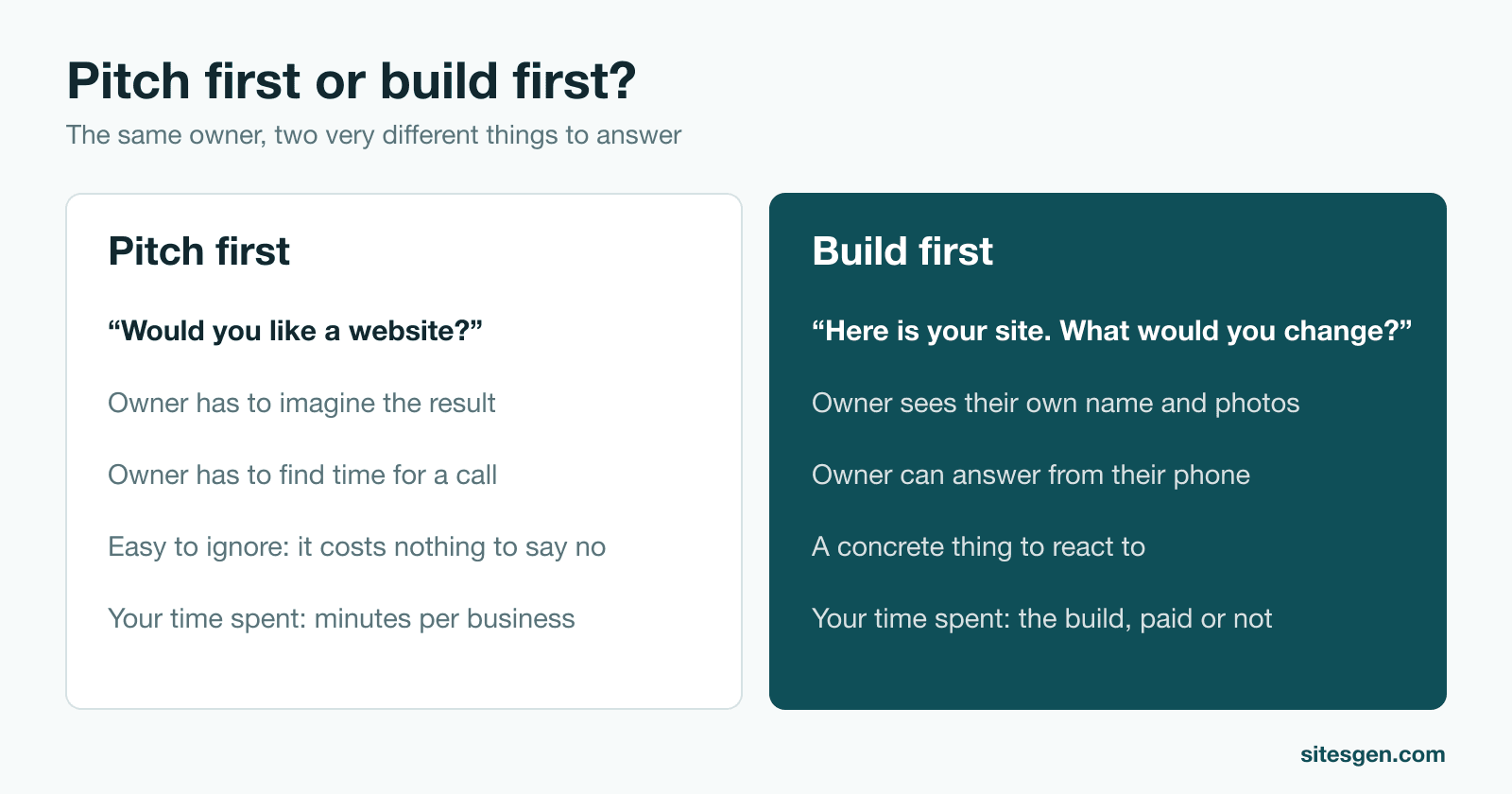
Short answer: yes, if a first version takes you minutes rather than days and you only build for businesses you have checked. No, if each demo means a full day of unpaid work. The method is sound, but the economics decide whether it works for you.
Why building first gets attention
A pitch asks an owner to imagine something. Most owners are too busy to imagine anything for a stranger. A link to a page with their own business on it replaces that with a much easier job: looking, and having an opinion. It also proves in one click that you did the work and can do it again.
You will see big reply-rate claims for this approach online. Treat them with care. Most come from individual freelancers or from people selling a demo tool, and no controlled comparison turned up in the research for this guide. It is a sensible method, not a measured guarantee. Test it yourself.
The case against: spec work
Unpaid work done in the hope of a sale is called spec work, and many designers object to it for good reasons. It devalues the work, and the risk sits entirely with you. Some owners also find an unasked-for mockup presumptuous. Those concerns are fair, and they lead to three rules:
- Spend little on each demo, so a “no” costs you almost nothing.
- Offer it as a draft for their opinion, never as something they now owe you for.
- Take no for an answer, the first time.
The numbers: when does a demo pay for itself?
Put a price on your time first. The Bureau of Labor Statistics puts the median US web developer wage at $44.54 an hour (May 2025). Freelancers need more than that to cover tax and unpaid hours, and the web design rates tool uses 1.25 to 2 times the wage, which is about $55 to $90 an hour. Your state may differ.
Take $60 an hour, a $1,500 site, and one sale from every 10 demos. That close rate is an assumption, so swap in your own:
| Time per demo | Cost per demo | Cost of 10 demos | Left from one $1,500 sale |
|---|---|---|---|
| 8 hours, custom by hand | $480 | $4,800 | −$3,300 |
| 3 hours, from a template | $180 | $1,800 | −$300 |
| 1 hour, template plus AI | $60 | $600 | $900 |
| 15 minutes, automated | $15 | $150 | $1,350 |
The table is the whole argument. At eight hours a demo, the method loses money unless nearly every demo closes. Under an hour, you can afford to be wrong most of the time. This is arithmetic rather than a forecast, and it ignores the time spent on the sale itself, but the shape holds.
Who to build for
Because demos cost something, choose carefully. Build only for a business that passes all of these:
- It has no site, or a broken one. The no-website finder and the bad website finder give you a starting list.
- It is independent, so the owner can actually say yes.
- It has recent reviews, which means it is trading and people look it up.
- You have enough real material: a menu, a price list, a service list.
- You know how to reach the owner.
What goes in a demo
Enough to feel real, and no more. A good first version has:
- The business name, the correct address, phone number and hours.
- The one thing customers need most. For a restaurant that is the menu, for a barber the prices.
- A few real reviews, with the source named.
- A clear label that this is a draft.
Skip extra pages, booking systems, blogs and anything that needs a decision from the owner. Those are reasons to talk once they are interested.
Keep it honest and private
This is the part most guides skip, and it is where the method can go wrong.
- Never publish before they agree. A public site using a business’s name can confuse its customers, and it can compete with them in search.
- Block search engines. Share a private preview link and mark it noindex.
- Do not invent anything. No made-up reviews, prices, awards or staff names. If you do not know a detail, leave it out.
- Ask about photos. Images found online belong to whoever took them. Use them in a private draft with care, and get permission or replace them before launch.
- Say who you are. Tell them you are offering a service, and remove the demo if they ask.
What to send
Ask for an opinion, not a purchase:
Hi Sam, your reviews mention the Saturday sourdough a lot, but it’s hard to find your hours online. I made a private draft of a site to show what it could look like: [link]. Nothing is public and you’re under no obligation. Is anything wrong or missing?
If they reply with changes, you have a conversation. If they ask what it costs, give a clear price and take it from there, as in the full guide to selling websites to local businesses. If they push back, here is what to say.
How to test this in a week
- Pick one trade and find 20 checked businesses.
- Send 10 a plain message offering to build a site.
- Send the other 10 a message with a demo link.
- Follow up once, and compare replies, calls and sales.
Twenty is a small sample, so read it as a hint and keep measuring. But it costs little and it tells you more than anyone’s screenshot of their results.
Getting the time per demo down
Everything rests on the first column of that table. Templates help, and reusing one layout across a trade helps more. SitesGen exists for this step: it finds the businesses in an area, builds each a finished site from its own photos and reviews, keeps it unpublished until you press Publish, and writes the pitch. Whichever way you build, keep your cost per demo low enough that a “no” does not hurt.