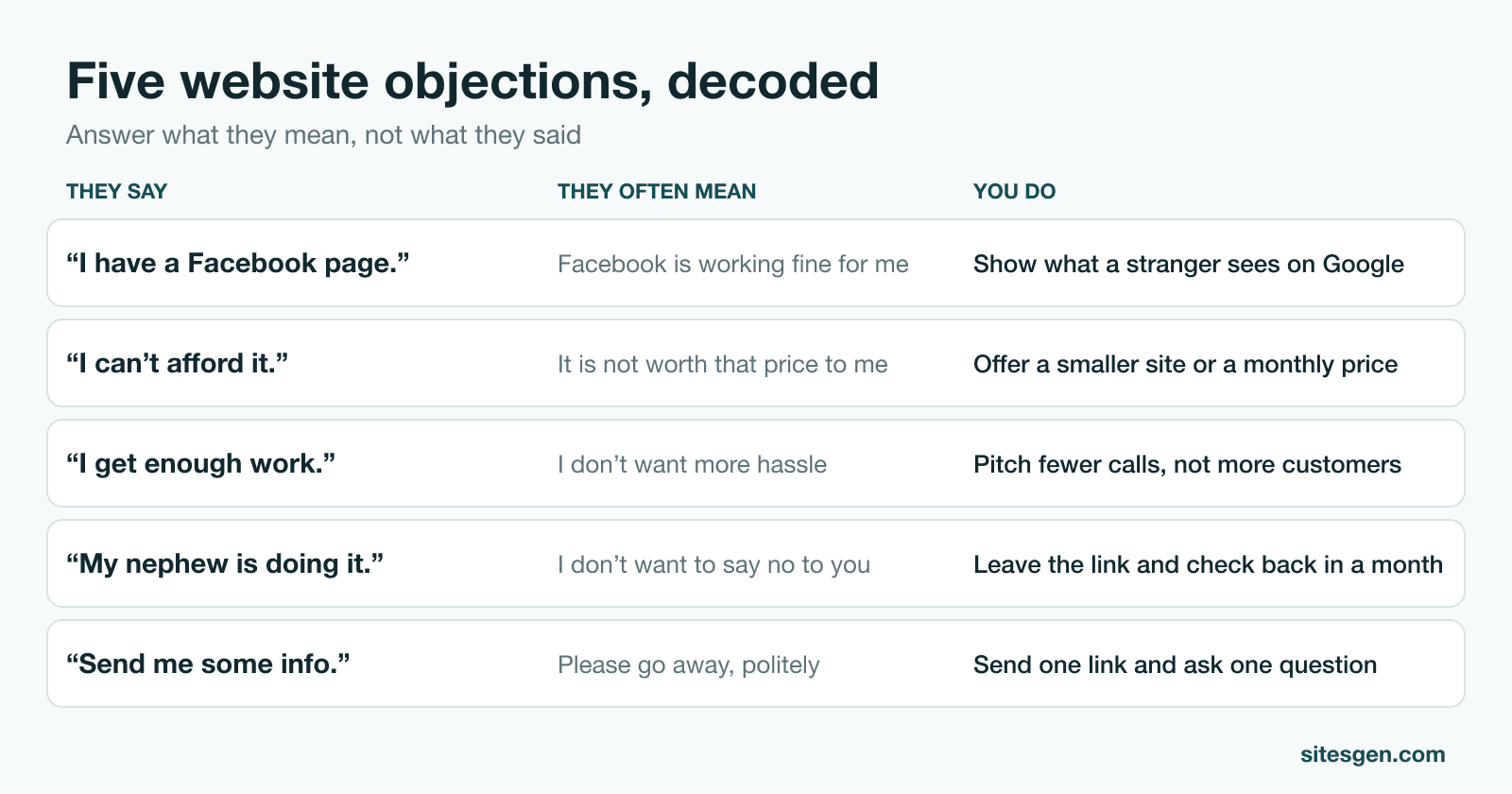
If you sell websites to local businesses, you will hear the same few objections all the time. They are rarely the real reason. An owner in the middle of a shift says whatever ends the conversation fastest. Your job is not to win the argument. It is to work out what they mean, and give them one easy next step.
The method: ask, agree, show, offer
Every reply below follows the same four moves:
- Ask one question, to find the real concern.
- Agree with whatever is true in what they said.
- Show something specific to their business, not a statistic.
- Offer a small step that is easy to accept.
Showing is much easier with a first version of their site in your hand, which is the case for building before you pitch. Adjust the wording until it sounds like you.
1. “I don’t need a website”
Often means: I’m doing fine, and I’ve never seen a website make me money.
Fair enough, and it sounds like word of mouth is working. Can I ask how someone who has never heard of you finds your hours or prices today?
Let them answer. If the answer is “they call” or “they don’t”, you have found the gap. If they really are full, thank them and move on.
2. “I have a Facebook page”
Often means: I’ve already handled the internet.
That’s good, keep it. Your regulars probably follow you there. I searched for you the way a new customer would, and here’s what came up.
Then show them the actual search on your phone. Do not criticise Facebook. Position the website as the one page they own, where the menu, prices and hours always live, with Facebook still doing its job for regulars.
3. “I can’t afford it”
Often means: I can’t see it paying for itself at that price.
That makes sense. What would a new customer be worth to you over a year? And would it help to do a smaller one-page version first, or spread it monthly?
Change the scope, not just the price. Fewer pages, a lower build fee with a longer monthly commitment, or a staged launch all keep your price honest. The pricing calculator shows what removing pages does to the total, and the cost guides by trade help when an owner has no idea what is normal.
4. “I already get enough work”
Often means: more customers sounds like more hassle.
Then I wouldn’t try to get you more. How many calls do you get just asking for your hours, prices or whether you’re open?
For a busy owner, a website is a way to get fewer interruptions and better-fit customers. If they really have no use for one, leave it. A fully booked plumber with a waiting list may be right.
5. “My nephew is doing one”
Often means: I don’t want to say no to your face. Sometimes, it also means there really is a nephew.
That’s great, family’s often the best way. I’ll leave the link with you anyway. If it ever helps as a backup, you know where I am.
Note the date, and check back in about a month. Do not argue with the nephew.
6. “I already paid for a website and it did nothing”
Often means: I got burned, and I don’t trust you yet.
That’s frustrating. What did you expect it to do, and what happened? I’d rather understand that than show you anything else.
Listen fully. Then promise only what you can control: it will load on a phone, it will show the right information, you will answer when they ask for a change. Never promise rankings or revenue. If you are rescuing a site that is actually broken, the bad website finder gives you a concrete problem to show them.
7. “Send me some information”
Often means: please leave, nicely.
Happy to. I’ll send one link, not a brochure. What’s the one thing you’d want a new customer to see first?
You have made the request smaller, and their answer tells you what to lead with. Send it within the day, then follow up once.
8. “I’ll think about it”
Often means: something is unresolved, and I don’t want to say what.
Of course. Is it more the price, the timing, or whether it’d actually help?
Offering three options makes it easy to answer, and the answer tells you which objection you are really dealing with. If they still want time, agree a day to check in and keep to it.
When to walk away
Some objections are right. A business that is closing, a franchise, or an owner who has said no twice is not a prospect. Leave on good terms: local owners talk, and today’s no can be next year’s referral. Pressure rarely pays off for a small monthly client you will have to deal with for years.
Practice before you need it
Say each reply out loud a few times. Write down the exact words owners use, then use those words in your next pitch. After 20 conversations, you will know which two or three objections matter in your trade. If that trade is food, the guide to selling websites to restaurants goes deeper. For the whole process, start with how to sell websites to local businesses.
These conversations get far easier when the site already exists. SitesGen builds a business its site from its own photos and reviews before you ever say hello, so “I don’t need one” turns into a talk about something real.