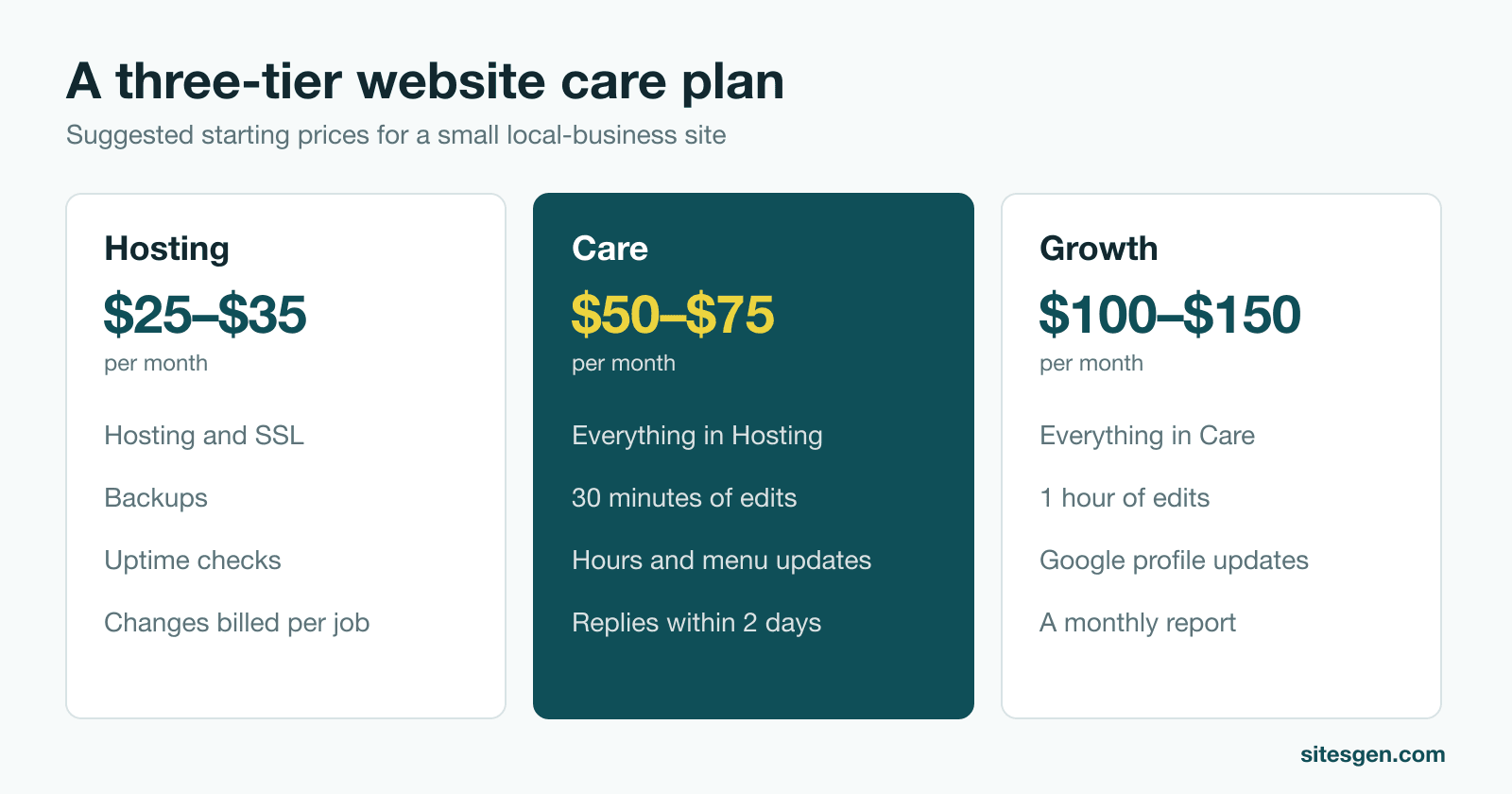
A website build pays once. A care plan pays every month, which is why many people who sell sites to local businesses treat it as the real business. For a simple small-business site, charge about $25 to $35 a month for hosting and backups, $50 to $75 with a small edit allowance, and $100 to $150 with more edit time and reporting. Here is how to set your own numbers, what to include, and how to sell it.
What other people charge
Published prices vary widely because “maintenance” means different things. One freelancer-focused guide suggests tiers of $35, $50 and $100 a month. Agencies looking after complex WordPress or ecommerce sites charge far more, and the price of a plan for a 200-page store tells you nothing about a five-page barber site. Compare yourself with people selling to the same kind of client.
Three plans to copy
Three options work well: enough choice to feel fair, few enough to decide on the spot. Most owners should land on the middle one, so make it the obvious pick.
| Hosting | Care | Growth | |
|---|---|---|---|
| Monthly price | $25–$35 | $50–$75 | $100–$150 |
| Hosting, SSL, backups | Yes | Yes | Yes |
| Uptime checks | Yes | Yes | Yes |
| Edits included | None, billed per job | 30 minutes | 1 hour |
| Reply time | 5 working days | 2 working days | 1 working day |
| Google profile updates | No | No | Yes |
| Monthly report | No | No | Yes |
| Best for | Sites that rarely change | Restaurants, salons, shops | Busier service businesses |
How to work out your own price
Do not copy the numbers blindly. Build them up from three things:
- Your hourly rate. The BLS median wage for US web developers is $44.54 an hour (May 2025). The rates tool multiplies wages by 1.25 to 2 for freelancers, which gives about $55 to $90 an hour nationally. Look up your own state.
- Your real time per client. Include checks, emails and small tasks, not just the edits. Log it for two months.
- Your costs. Hosting, tools, and any plugin or service fees.
The formula is short: monthly price = (hours per month × hourly rate) + monthly costs per client.
Example, at $70 an hour with $5 of costs per client:
| Time per month | Labour | Costs | Minimum price |
|---|---|---|---|
| 15 minutes | $17.50 | $5 | $22.50 |
| 30 minutes | $35 | $5 | $40 |
| 45 minutes | $52.50 | $5 | $57.50 |
| 1.5 hours | $105 | $5 | $110 |
Note that a Care plan with 30 minutes of edits really takes longer than 30 minutes once you add email and checks. That is why $50 to $75 is the range, and not $40. Not every client uses their allowance, but plan as if most will.
What to put in the agreement
Most care plan trouble comes from unclear limits. A one-page agreement should say:
- What counts as an edit: changing text, hours, prices, photos.
- What does not: new pages, redesigns, new features. Quote those separately.
- Whether unused time rolls over. The simple answer is no.
- Your reply time, in working days.
- The notice period. 30 days is simple and fair.
- Who owns the domain and content, and how they get them if they leave.
- What you do not promise, such as search rankings or a set number of leads.
How to sell the plan
The best moment is when you quote the site. Do not present the plan as an extra. Present it as how the site stays right:
The site is $1,200. After launch, most owners take the $60 plan. That covers hosting, backups and small changes, so if your hours or prices change, you send me a text and it’s done. Want that included?
Lead with what it saves them, not the technical list. An owner will not value “security patches” but does understand “you’ll never have to log in to anything”. Trades with changing information are the easiest sale. Restaurants update menus and hours all year, for example.
If an owner says the plan is too much, drop a tier rather than a price. If they say the build is too much, a lower build fee with a 12-month plan commitment can work. The objections guide has more replies for this moment.
What it adds up to
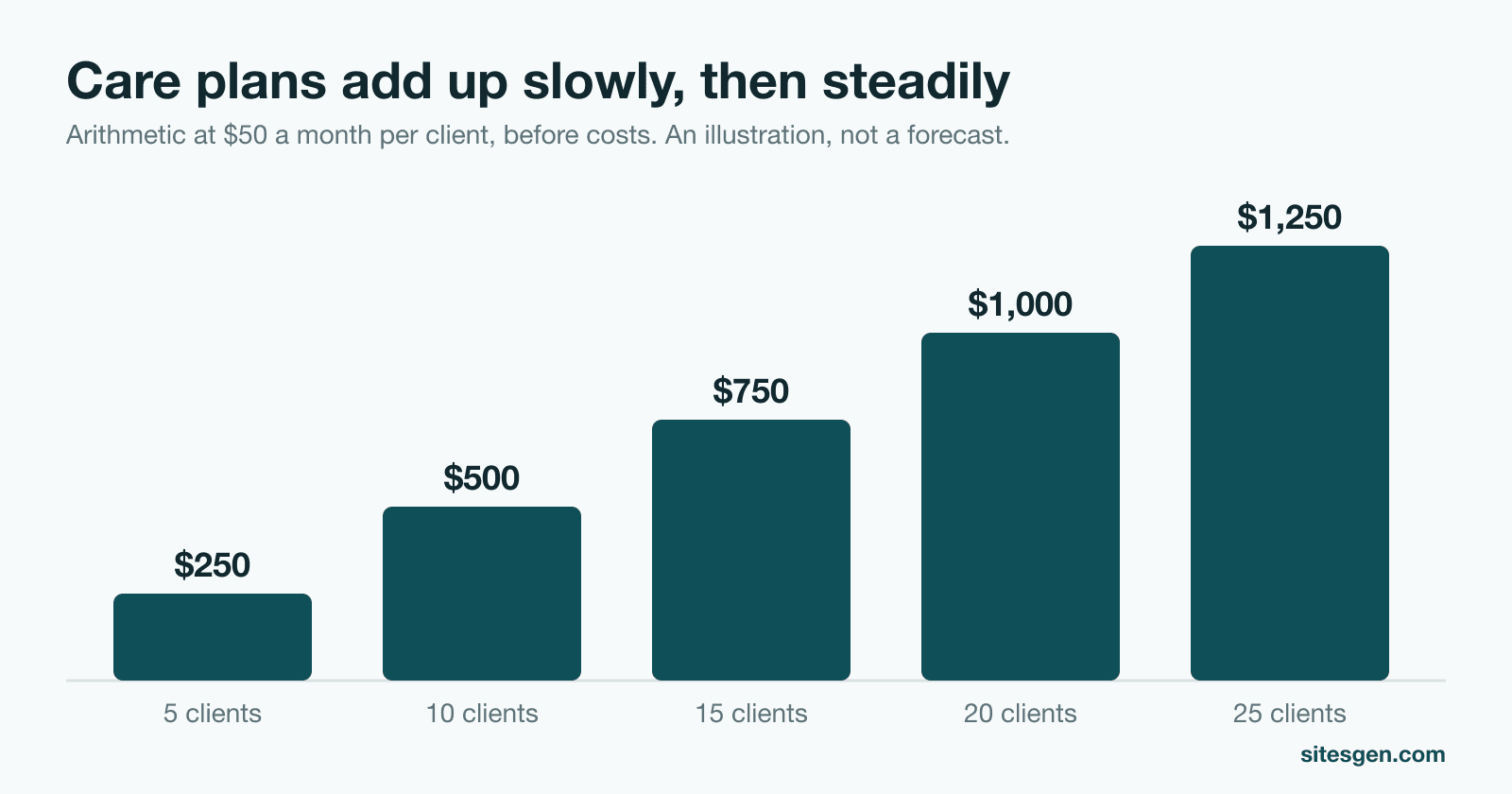
Care plans are slow. Five clients will not change your life. But revenue that repeats means each new site adds to the last, instead of starting again from zero each month. Model it with your own numbers in the income calculator.
Keeping your costs low
Your margin depends on how long each small job takes. Simple static sites on managed hosting need far less care than a site full of plugins. Standardise on one setup, keep a template for your monthly checks, and batch edits on one day a week.
If you sell sites through SitesGen, hosting is included in your plan: Starter covers 5 live client sites for $19 a month, and Pro covers 25 for $39. You set your own prices, and SitesGen takes no share of what you charge. Five clients on a $50 plan is $250 a month against a $19 bill, before your time. New to selling? Start with how to sell websites to local businesses.